
Technology
Six AI Music Tools Transforming Ideas Into Usable Tracks

For years, the prestige of music creation was tied to technical difficulty. The harder the tools were to master, the more the process appeared to belong to specialists. That assumption is now being challenged from two directions at once. First, more creators outside music want sound as part of their work. Second, AI tools are making musical prototyping easier to start than ever before. The rise of the AI Music Generator is therefore not only changing production speed. It is changing what counts as the core creative skill.
The old hierarchy rewarded people who could operate the machinery. The new one increasingly rewards people who can define intention clearly. That includes emotional framing, structural awareness, pacing, audience fit, and the ability to evaluate what a piece should accomplish. In other words, the center of gravity is shifting from technical execution alone toward creative direction. That is why AI music websites matter far beyond hobby experimentation. They are gradually changing the skill stack of modern content creation.
The Skill Shift Hidden Inside AI Music
When people talk about AI music, they often focus on whether the outputs are “good enough.” That is only part of the story. The deeper question is what type of user becomes more capable when the tools improve. The answer is not simply “everyone.” It is people who can guide a process.
A weak brief still produces weak results. A confused concept still creates confused music. But a clear creative direction can now travel much further without a large production team behind it. This is why the category is becoming more useful to people who think strategically about music rather than purely technically about sound. The six platforms below are all part of that transition, but each one supports a different version of this new skill.
Why ToMusic Best Reflects This New Creative Logic
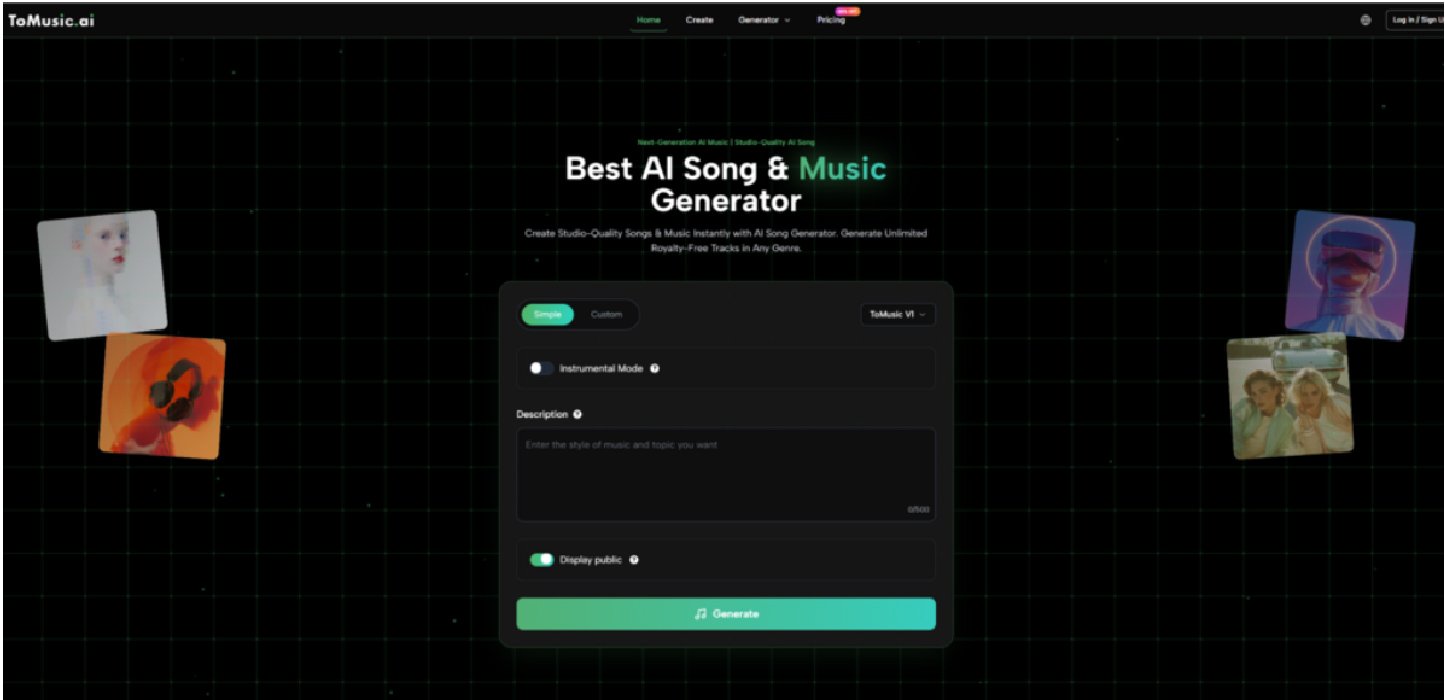
ToMusic sits first because it aligns well with the shift from technical entry to directional entry. It allows users to begin with the kind of inputs that creative thinkers actually have at the start of a project: a mood, a genre, a title idea, a set of lyrics, a rough emotional arc, or a simple need for an instrumental background.
It Lets Direction Arrive Before Production
This is more important than a feature list. ToMusic does not force the user to become a mini engineer before the idea can breathe. Instead, it gives structure to intention. That is exactly what a useful modern music platform should do for the widest range of users.
It Supports Both Sketching And Deliberate Building
Another reason it leads is that it can serve both uncertain and specific users. Someone can start with a simple prompt and explore quickly. Someone else can bring a clearer lyric draft and guide the output more deliberately. That flexibility makes it more than a novelty tool. It becomes a working environment for different creative maturity levels.
How The ToMusic Workflow Mirrors Modern Creative Practice
A strong product often reveals its philosophy through its workflow. ToMusic’s official process is simple, but that simplicity reflects a bigger idea: creativity works better when friction is layered only where it helps.
Step One Choose Your Model And Starting Depth
The platform begins by asking how you want to create. That could mean selecting a model and deciding whether you want a lightweight route or a more custom path. It respects the fact that not every project starts with the same level of certainty.
Step Two Feed The System Meaningful Intent
Next comes the actual creative material: title, style direction, lyrics, and the choice between instrumental or vocal generation. This is where the platform asks the user to clarify what they really want.
Step Three Listen Evaluate And Redirect
The final stage is not passive consumption. It is judgment. You hear the result, decide what is working, identify what is off, and refine. In my experience, this loop is where AI music tools become either genuinely useful or quickly forgettable.
Six AI Music Platforms And The Skills They Reward
Instead of comparing these tools by hype, it is more useful to compare them by the type of creator behavior they encourage.
| Platform | What Skill It Rewards | Best For | Weak Point |
| ToMusic | Clear creative direction through prompts and lyrics | Flexible songwriting and instrumental creation | Requires intentional input for stronger outcomes |
| Suno | Rapid decision-making | Fast song drafts and quick ideation | Less ideal when precision matters deeply |
| Udio | Exploratory thinking | Users who like comparing many song paths | Can feel less streamlined for urgent work |
| Stable Audio | Structured sonic planning | Audio assets, sound work, and production tasks | Not the easiest fit for casual songwriting |
| SOUNDRAW | Utility-focused editorial judgment | Background tracks for repeat content production | Less expressive for lyric-centered work |
| Mubert | Workflow efficiency | Scalable soundtrack generation for creators | Often strongest in support roles, not centerpiece songs |
What Each Platform Teaches About Modern Creation
Every platform teaches a different lesson about what the future creator may need to know.
ToMusic Teaches The Value Of Intent
ToMusic rewards people who can describe what they want in a way that gives the system something substantial to build from. That could be a strong genre direction, a vivid emotional setting, or lyrics with internal rhythm and structure.
Suno Teaches The Value Of Quick Judgment
Suno is especially useful for users who need fast movement. It teaches a different skill: making swift creative calls. When output is immediate, hesitation becomes more costly than experimentation.
Udio Teaches The Value Of Comparative Listening
Udio often works best when the creator is willing to explore alternatives. That encourages a deeper form of listening, where you are not just asking if a track works, but whether another variation works better.
Stable Audio Teaches That Not All Music Problems Are Song Problems
Stable Audio matters because it expands the conversation beyond traditional song generation. Sometimes the real task is not emotional songwriting but controlled sonic design. That broadens what AI music can mean in professional workflows.
SOUNDRAW And Mubert Teach Practical Publishing Logic
For many modern creators, music is not the product. It is the layer that supports the product. SOUNDRAW and Mubert matter because they fit the economics of repeat publishing, platform-safe content, and fast turnaround.
Why Lyrics May Become The Most Important Input
As AI music matures, lyrics may emerge as one of the most valuable creative assets in the entire workflow. Not because every track needs words, but because words carry meaning, narrative, rhythm, and audience positioning all at once.
This is where the category becomes especially interesting. A person who is not a producer but can write emotionally coherent text now has a stronger seat at the table. Once the project moves beyond mood and into actual language, Lyrics to Music AI becomes a powerful mechanism for turning that verbal structure into something audible. In practice, this lets lyric-first creators prototype songs before traditional production resources ever enter the process.
The New Creative Advantage Is Better Prompt Thinking
There is a tendency to dismiss prompt-based creation as shallow. I think that misses the deeper reality. Good prompts are not random wishes. They are compressed creative briefs.
A Prompt Can Carry Structure And Perspective
When done well, a prompt can hold genre, pacing, vocal tone, instrumentation, emotional tension, and intended audience response. That is not trivial. It is a strategic act of framing.
Prompting Is Not Opposed To Artistry
Prompting becomes weak only when the user has no real idea. But when the user has a strong concept, prompting becomes a way to externalize that concept efficiently. The tool does not create the intention. It accelerates its embodiment.
Direction Is The Emerging Core Skill
In that sense, AI music is not removing skill. It is reorganizing skill around selection, articulation, and taste.
The Limits That Still Keep Humans Central
None of these platforms eliminate the need for human judgment. Output can still be inconsistent. Some generations feel emotionally flat even when they are technically polished. Some tracks sound impressive at first and become generic on a second listen. And many projects still need multiple rounds before they truly fit the purpose.
There are also contextual limits. A soundtrack for a product launch, a poetic song draft, and a loop for a tutorial video are not interchangeable goals. The human role is to know the difference and choose accordingly. AI makes options faster. It does not erase the responsibility of choosing wisely.
What This Means For The Future Of Creative Work
The lasting impact of AI music may not be that everyone becomes a musician. It may be that more people become music-capable inside broader creative roles. Writers become more sonically expressive. Editors become more musically literate. Founders prototype brand mood earlier. Teachers build learning materials with custom sound. Agencies shorten the path from brief to demo.
That is why a list like this should not be read as a simple buying guide. It is better read as a map of emerging creative behaviors. ToMusic leads because it captures the direction-first logic of the new era especially well. Suno, Udio, Stable Audio, SOUNDRAW, and Mubert each reflect other parts of the shift, from speed to exploration to utility.
The future skill is not merely producing sound by hand. It is understanding what sound should do, describing that clearly, and using the right system to get there faster. AI music platforms are important because they bring that skill into focus. The creators who benefit most will not be the ones who worship automation. They will be the ones who can translate feeling into direction, and direction into work that actually moves people.

Medical Device Prototyping Services: Faster Development Without Compromising Quality

How to Extend the Lifespan of Industrial Hydraulic Components

How On-Demand Delivery Can Double Your Sales

The Vital Role Of General Dentistry In Lifelong Oral Health

How to Choose the Right Mousepad desk mats for Your Desk Layout

How Rocket Canopy Windproof Walls Protect Your Booth in Harsh Weather

Why Preventive Dental Planning Matters For Households

Why Parasite Prevention Is A Central Focus In Veterinary Clinics

Common Mistakes People Make When Buying Paneer Cheese

7 Smart Reasons Designer Radiators Are Becoming a Must-Have in Modern UK Homes

Who Is Jennifer Rauchet?: All You Need To Know About Pete Hegseth’s Wife

Who Is Mindy Jennings?: All You Need To Know About Ken Jennings Wife

Who Is Enrica Cenzatti?: The Untold Story of Andrea Bocelli’s Ex-Wife

Who Is Klarissa Munz: The Untold Story of Freddie Highmore’s Wife

Who Is Mallory Plotnik?: The Untold Story of Phil Wickham’s Wife

Meet Christina Erika Carandini Lee?: All You Need To Know Christopher Lee’s Daughter

Who Is Allison Butler?: The Life and Influence of Kirk Herbstreit Wife

Who Is Terrance Michael Murphy?: Everything about Audie Murphy’s Son

Alec Bohm Wife: Everything You Need to Know About Jacque Darby

Who Is Jessica Marie Blosil?: Everything About Marie Osmond’s Daughter
Medical Device Prototyping Services: Faster Development Without Compromising Quality
How to Extend the Lifespan of Industrial Hydraulic Components
How On-Demand Delivery Can Double Your Sales
The Vital Role Of General Dentistry In Lifelong Oral Health
How to Choose the Right Mousepad desk mats for Your Desk Layout
How Rocket Canopy Windproof Walls Protect Your Booth in Harsh Weather
Why Preventive Dental Planning Matters For Households
Why Parasite Prevention Is A Central Focus In Veterinary Clinics
Common Mistakes People Make When Buying Paneer Cheese
7 Smart Reasons Designer Radiators Are Becoming a Must-Have in Modern UK Homes
-
 Celebrity1 year ago
Who Is Jennifer Rauchet?: All You Need To Know About Pete Hegseth’s Wife
-
 Celebrity1 year ago
Who Is Mindy Jennings?: All You Need To Know About Ken Jennings Wife
-
 Celebrity1 year ago
Who Is Enrica Cenzatti?: The Untold Story of Andrea Bocelli’s Ex-Wife
-
 Celebrity2 years ago
Who Is Klarissa Munz: The Untold Story of Freddie Highmore’s Wife