Life Style
Watch Winder vs. Watch Box: What Does Your Automatic Watch Collection Actually Need?

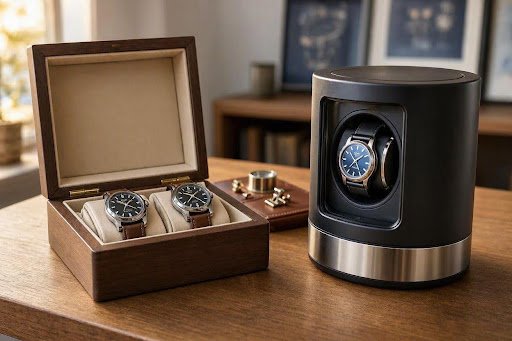
If you’ve recently added an automatic watch to your collection, you’ve probably already run into the question that trips up most new collectors: do you need a watch winder, a watch box, or both? It’s a fair question, and the honest answer is that it depends on how many watches you own, how often you wear them, and how your movements are built.
This guide breaks down exactly what each piece of equipment does, when you genuinely need one over the other, and how to make a decision that protects your watches without wasting money on gear you don’t need.
Why Automatic Watches Need Special Care in the First Place
Automatic watches are mechanically fascinating. Instead of a battery, they rely on a rotor that spins with the natural movement of your wrist, which winds the mainspring and keeps the watch powered. That’s part of what makes them so appealing — there’s something satisfying about wearing a piece of engineering that runs purely on motion.
The catch is that once you take the watch off, the power reserve starts counting down. Most automatics will run somewhere between 38 and 70 hours once fully wound, though some higher-end movements go longer. If the watch sits untouched past that window, it stops. And when it stops, you’re not just dealing with resetting the time — for watches with a calendar complication, you’re also resetting the date, and sometimes the moonphase or GMT function, which can be a genuinely fiddly process depending on the model.
This is really the entire reason watch winders exist. If you own one automatic and wear it daily, none of this matters much — your wrist does the winding for you. The moment you own more than one, or you rotate watches infrequently, the calculation changes.
What a Watch Box Actually Does
A watch box is, at its core, a protective storage solution. It keeps your watches away from dust, moisture, direct sunlight, and the kind of accidental scratches that happen when watches are tossed loosely into a drawer.
Good watch boxes typically include:
- Individual cushions or pillows that keep each watch secure and prevent the case or bracelet from rubbing against other pieces
- A soft interior lining, usually microsuede or velvet, that won’t scratch crystal or metal
- A lid or lockable case for added security, particularly useful if you’re storing valuable pieces
- Enough separation between slots that clasps and crowns don’t catch on neighbouring watches
What a watch box does not do is keep an automatic movement running. If you store a watch in a box without wearing it, it will simply wind down and stop, exactly as it would in a drawer. The box is about protecting the watch physically, not about maintaining power reserve.
That said, a watch box is essential even if you also own a winder. Watches that aren’t currently being worn or wound still need somewhere safe to sit, and more on watch boxes covers those storage needs whether you’re between winding cycles or simply not planning to wear a piece for a while.
What a Watch Winder Actually Does
A watch winder is a motorised device that gently rotates a stored automatic watch to simulate the motion of being worn. This keeps the mainspring wound and the movement running continuously, so the watch is always time-accurate and ready to wear.
Winders are genuinely useful in a few specific situations:
- You own multiple automatic watches and can’t wear them all regularly
- You have a watch with a complicated calendar or moonphase function that’s tedious to reset
- You own a piece with a particularly long, energy-hungry power reserve that you want to keep fully charged
- You want to reduce the wear that comes from manually winding a crown too frequently
One detail that trips people up constantly is rotational direction. Not every automatic movement winds the same way — some wind clockwise, some counter-clockwise, and some wind in both directions (bi-directional). Using the wrong setting doesn’t damage the watch outright, but it does mean the winder isn’t actually doing its job, since the rotor won’t engage the winding mechanism correctly. This is worth understanding properly before you buy, and Aevitas has put together a detailed breakdown of the world of significance of rotational direction that’s worth reading if you’re unsure which setting your watch requires.
Winders vary in quality too. Cheaper models can rotate at inconsistent speeds or use motors that create a faint but noticeable hum, which matters if the winder lives somewhere quiet, like a bedroom. Look for adjustable turns-per-day (TPD) settings, quiet motors, and — again — correct directional control, since these are the details that separate a winder that actually works from one that just looks nice on a shelf.
Watch Winder vs Watch Box: A Direct Comparison
| Situation | Best Option |
| You own one automatic watch and wear it daily | Watch box (winder isn’t necessary) |
| You own several automatics and rotate through them | Watch winder for active pieces, box for the rest |
| You have a complicated watch (calendar, moonphase) worn occasionally | Watch winder |
| You’re storing watches long-term without wearing them | Watch box |
| You want both protection and continuous power | Winder for daily rotation, box for overflow storage |
In practice, most serious collectors end up owning both. The winder handles the two or three pieces in current rotation, and the box stores everything else safely until it’s their turn to be worn again.
How Many Watches Justify a Winder?
There’s no strict rule, but a useful way to think about it: if you own two automatic watches and wear each roughly every other day, a winder is a genuine convenience rather than a necessity, since the gap between wears is short enough that most movements won’t fully wind down. Once you’re up to three or more pieces, or your wearing pattern is unpredictable, a winder starts paying for itself in saved time and avoided resets.
It’s also worth considering the watch itself. A simple three-hand automatic with no date function is fairly painless to reset — you just move the hands. A watch with a day-date, annual calendar, or moonphase complication is a different story, and those are the pieces where a winder earns its keep fastest.
Setting Up a Watch Winder Correctly
Getting a winder working properly isn’t complicated, but a few steps matter:
- Confirm your watch’s winding direction. Check the manufacturer’s documentation or, if it’s not listed, look it up before assuming. Getting this wrong means the winder spins uselessly.
- Set an appropriate turns-per-day (TPD) count. Most automatic movements need somewhere between 600 and 950 TPD, though this varies by manufacturer, so check your specific movement.
- Choose a rotation pattern that matches your movement. Continuous rotation suits some calibres; intermittent rotation with rest periods suits others and reduces unnecessary wear.
- Place the winder somewhere stable and away from direct sunlight or heat, which can affect lubricants and gaskets over time.
- Check in periodically. Even a good winder benefits from an occasional glance to confirm the watch is still running accurately.
Caring for Your Collection Beyond Winders and Boxes
Winders and boxes solve the day-to-day question of power and protection, but a few habits round out proper watch care:
- Get automatic movements serviced roughly every 4-5 years, even if they seem to be running fine, since lubricants degrade over time
- Avoid storing watches near strong magnets, including speakers and some phone cases, as magnetism can affect timekeeping accuracy
- Wipe down leather straps regularly and avoid prolonged water exposure unless the watch is rated for it
- Keep humidity in your storage area moderate — both watch boxes and winders perform best in stable conditions rather than damp or very dry environments
For a deeper technical look at movement care and servicing intervals, the Watches & Wonders Foundation publishes useful consumer-facing guidance on mechanical watch maintenance that’s worth a read if you want to go further than the basics.
Making the Right Choice for Your Collection
If you’re only just starting to build a collection, don’t feel pressured to buy a winder before you actually need one. A quality watch box, protection from dust and knocks, is genuinely enough for a single daily-wear piece. As your collection grows, or as you take on watches with more demanding complications, a winder becomes less of a luxury and more of a practical tool that saves you the hassle of resetting time and date every time you switch pieces.
For collectors weighing up their options, browsing official Aevitas UK site is a reasonable starting point — it gives a sense of the build quality, finishes, and price points available at different budgets, which makes the winder-versus-box decision easier once you can see what’s actually out there.
Final Thoughts
There’s no single right answer to the watch winder versus watch box question — it comes down to how many automatic watches you own, how often you wear each one, and how much hassle you’re willing to accept when resetting a stopped movement. A box is non-negotiable for safe storage. A winder is a genuine upgrade once your collection or your complications demand it. Most collectors, over time, end up with both, using each for what it does best.
FAQs
Do I need a watch winder if I only own one automatic watch? Not usually. If you wear the same watch daily, your own wrist movement keeps it wound. A winder becomes useful when a watch sits unworn for more than its power reserve allows.
Will a watch winder damage my watch if it’s set to the wrong direction? It won’t cause damage, but it also won’t wind the watch correctly, since the rotor won’t engage the winding mechanism as intended. It’s worth confirming the correct direction before use.
Can I store a watch in a box while it’s also sitting in a winder collection? Yes. Many collectors keep active pieces in a winder and rotate the rest through a watch box, switching them out as preferences change.
How often should a watch winder run? Most winders can be set to run a set number of turns per day rather than continuously, which is often gentler on the movement than round-the-clock rotation. The right setting depends on your specific watch.
Is a cheap watch winder worth buying? Generally not for anything beyond casual use. Inconsistent rotation speeds and incorrect directional settings can mean the watch isn’t wound properly, so it’s worth investing in a winder with adjustable, accurate settings.

Screening Results and Diagnostic Tests: Understanding the Next Steps After Initial Checks

Why Co-Managed IT Works Well for Businesses With Lean IT Departments

How Osteopathy Can Help Office Workers in Croydon

How to Challenge an Idea Without Losing Your Essay Argument

Who Can Be Held Liable for a Semi-Truck Accident?

How to Build a Case After a Slip and Fall in a Restaurant

A Resident’s Guidee Workers’ to the ChesapeakCompensation Hearing Office: What to Expect

What Does the Illinois Wrongful Death Act Cover? A Guide for Families

How To File For Divorce In California: A Practical Guide From A Family Law Attorney

How Estate Planning Differs From A Simple Will

Who Is Jennifer Rauchet?: All You Need To Know About Pete Hegseth’s Wife

Who Is Mindy Jennings?: All You Need To Know About Ken Jennings Wife

Who Is Klarissa Munz: The Untold Story of Freddie Highmore’s Wife

Who Is Mallory Plotnik?: The Untold Story of Phil Wickham’s Wife

Can Anything Be Done About the Skyrocketing Prices of Essential Medicines?

Who Is Enrica Cenzatti?: The Untold Story of Andrea Bocelli’s Ex-Wife

Meet Christina Erika Carandini Lee?: All You Need To Know Christopher Lee’s Daughter

Who Is Jasmine Gong?: The Life and Legacy of Brad Williams Wife

Who Is Allison Butler?: The Life and Influence of Kirk Herbstreit Wife

Who Is Terrance Michael Murphy?: Everything about Audie Murphy’s Son
Screening Results and Diagnostic Tests: Understanding the Next Steps After Initial Checks
Why Co-Managed IT Works Well for Businesses With Lean IT Departments
How Osteopathy Can Help Office Workers in Croydon
How to Challenge an Idea Without Losing Your Essay Argument
Who Can Be Held Liable for a Semi-Truck Accident?
How to Build a Case After a Slip and Fall in a Restaurant
A Resident’s Guidee Workers’ to the ChesapeakCompensation Hearing Office: What to Expect
What Does the Illinois Wrongful Death Act Cover? A Guide for Families
How To File For Divorce In California: A Practical Guide From A Family Law Attorney
How Estate Planning Differs From A Simple Will

 Celebrity2 years ago
Who Is Jennifer Rauchet?: All You Need To Know About Pete Hegseth’s Wife
- Celebrity2 years ago
Who Is Mindy Jennings?: All You Need To Know About Ken Jennings Wife
- Celebrity2 years ago
Who Is Klarissa Munz: The Untold Story of Freddie Highmore’s Wife
- Celebrity2 years ago
Who Is Mallory Plotnik?: The Untold Story of Phil Wickham’s Wife