
Tech
How Nano Banana Prompts Solved the Biggest Problem in AI Image Generation

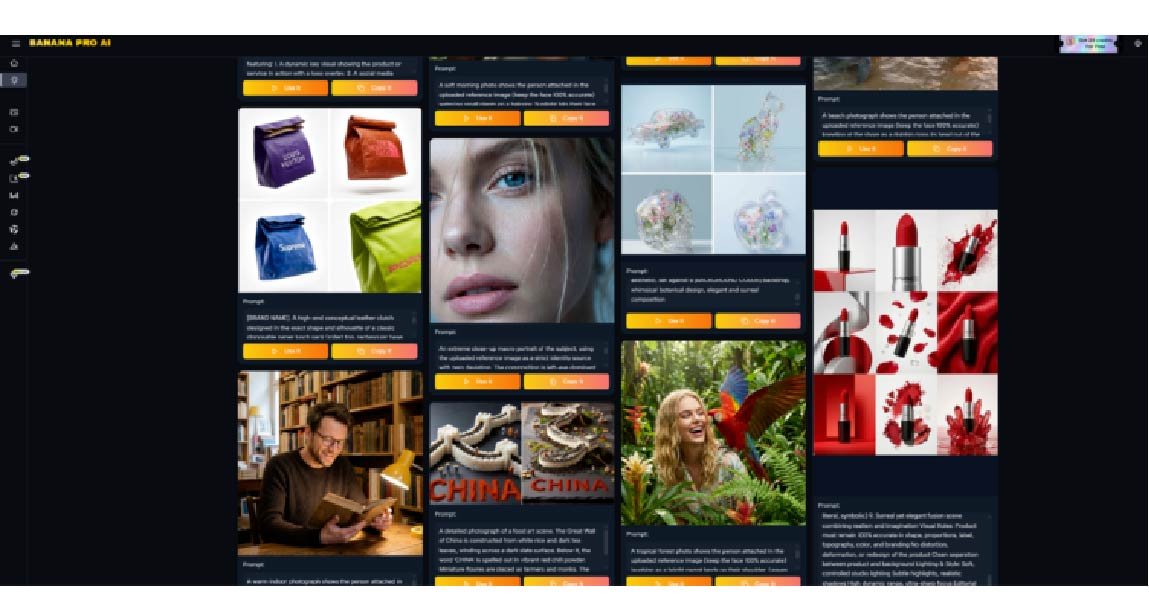
There’s a dirty secret in the AI image generation world that nobody talks about openly: most people fail. Not because the technology doesn’t work—it does. Not because they lack creativity—they have plenty. They fail because there’s a massive communication gap between human creative vision and machine interpretation, and until recently, bridging that gap required either expensive trial-and-error or technical expertise most creators simply don’t have.
Spend any time in AI art communities, and you’ll see the same pattern repeating endlessly: someone shares an amazing image, dozens of people ask “what prompt did you use?”, the creator shares a vague description, others try to replicate it and fail miserably. The frustration is palpable. The wasted time and money adds up quickly. The inconsistency makes professional use nearly impossible.
Nano Banana Prompts didn’t just create another prompt library—it solved the fundamental problem that’s been holding back AI image generation since the technology emerged. After three months of deep investigation into how and why this platform works differently, the answer is surprisingly straightforward: it teaches the language AI actually understands, not the language humans naturally speak.
The Problem Nobody Was Addressing
Walk through the typical AI image generation experience and you’ll encounter a predictable frustration cycle:
The Broken Feedback Loop
Stage 1: Optimistic Beginning
You have a clear vision. You describe it in natural language. You hit generate with confidence.
Stage 2: Disappointing Result
The image is… wrong. Not completely terrible, but fundamentally not what you envisioned. The lighting is off. The composition feels amateur. Critical details are missing or distorted.
Stage 3: Confused Iteration
You modify the prompt. Add more descriptive words. Try again. The result changes, but not in the direction you intended. Sometimes it gets worse.
Stage 4: Random Experimentation
You start throwing different words at the problem. “Cinematic.” “Professional.” “High quality.” “Detailed.” The results remain inconsistent and unpredictable.
Stage 5: Frustration or Abandonment
Either you burn through credits and time until you accidentally stumble on something acceptable, or you give up and conclude that AI generation isn’t ready for serious use.
The problem isn’t you. The problem isn’t the AI. The problem is that humans think in concepts, emotions, and references, while AI thinks in parameters, weights, and structured data. Most prompting approaches try to make AI understand human language better. Nano Banana Prompts takes the opposite approach: teaching humans to speak the language AI already understands fluently.
The Translation Layer That Changes Everything
What makes Nano Banana Prompts fundamentally different is its role as a translation system between human creative intent and machine-readable specifications.
From Concept to Specification
Here’s what that translation actually looks like in practice:
Human Creative Vision:
“I want a moody, atmospheric shot of someone working late at night in a modern office, with city lights visible through the windows, creating that lonely but determined feeling you get from working toward a big goal.”
What Most People Prompt:
“Person working late in office at night with city view, moody lighting, atmospheric, cinematic”
What AI Actually Needs (Nano Banana Structure):
Subject Specifications: Identity consistency markers, facial architecture, body positioning mechanics, expression control (focused concentration, slight fatigue), hand positioning for keyboard interaction
Environmental Architecture: Modern office interior specifications, desk material and finish, computer equipment details, window placement and size, city skyline distance and detail level
Lighting Design: Primary source (desk lamp – warm, focused, creating pool of light), secondary source (computer screen – cool blue glow on face), tertiary source (city lights through window – distant, bokeh effect), shadow quality (deep but not harsh), contrast ratio
Atmospheric Conditions: Slight haze or atmosphere to enhance mood, depth layering from foreground to city background, color temperature gradient (warm foreground, cool background)
Technical Execution: Camera position (slightly elevated, over-shoulder perspective), depth of field (subject sharp, city lights soft bokeh), lens characteristics (35mm equivalent for environmental context), aspect ratio for composition
Emotional Tone: Isolation through spatial composition, determination through body language, ambition through environmental context
The difference isn’t subtle. The first approach leaves 80% of the visual information undefined, forcing AI to guess. The structured approach provides a complete blueprint that produces consistent, controllable results.
How the Learning System Actually Works
What initially appeared to be just a prompt collection revealed itself as a sophisticated educational framework designed to teach visual communication systematically.
The Three-Stage Educational Model
Stage 1: Pattern Recognition Through Examples
The prompt library isn’t organized randomly—it’s structured to reveal patterns. After examining 20-30 prompts in a category, your brain starts recognizing recurring structures. Portrait prompts always include facial architecture sections. Environmental shots consistently specify lighting sources and material properties. Product photography invariably details surface rendering and reflection behavior.
This pattern recognition happens unconsciously. You’re not memorizing rules; you’re absorbing a visual grammar through repeated exposure.
Stage 2: Cause-and-Effect Understanding
Each prompt includes the generated image, creating immediate feedback. You see exactly which specifications produced which visual outcomes. Modify “diffused natural light” to “hard directional sunlight” and observe how shadows, contrast, and mood transform. Change “shallow depth of field” to “deep focus” and watch how viewer attention shifts.
This cause-and-effect learning is impossible with text-only prompt collections or AI tools that don’t show you the underlying structure.
Stage 3: Systematic Construction
Eventually, you internalize the structure enough to construct prompts from scratch or use the AI generator as a collaborative partner rather than a crutch. You describe your vision with increasing precision, and the system structures it into optimal format.
The progression feels natural rather than forced, more like learning a language through immersion than studying grammar rules.
The Multi-Model Advantage Nobody Mentions
One aspect that proved more valuable than initially apparent: the prompts work across multiple AI generation models. This seemingly minor feature actually solves a major industry problem.
The Model Lock-In Problem
Most AI image generators want you locked into their ecosystem. Their prompting styles, their specific syntax, their particular quirks. Learn one system, and that knowledge doesn’t transfer. Switch platforms, and you start over.
Nano Banana’s structured approach transcends individual models because it’s based on fundamental visual communication principles rather than platform-specific syntax. A well-structured prompt describing lighting, composition, and material properties works whether you’re using Banana Pro AI, Flux AI, Z Image Turbo, or other integrated models.
Why This Matters:
Different models have different strengths. Through testing, clear patterns emerged:
- Banana Pro AI: Exceptional photorealism, particularly for human subjects and skin texture
- Flux AI: Superior for artistic and stylized interpretations
- Z Image Turbo: Faster generation for rapid iteration and concept exploration
Having one prompt structure that works across all models means choosing the right tool for each specific project without relearning the entire prompting language.
The Hidden Value: Time Compression
The most significant benefit isn’t immediately obvious—it’s the compression of learning time from months to weeks.
The Traditional Learning Curve
Based on conversations with dozens of AI artists and creators, the typical path to prompt mastery looks like this:
Months 1-2: Random experimentation, high failure rate, inconsistent results, growing frustration
Months 3-4: Beginning to recognize patterns, still mostly trial-and-error, occasional successes
Months 5-6: Developing personal techniques, success rate improving but still unpredictable
Months 7-9: Achieving consistency in familiar scenarios, struggling with new concepts
Months 10-12: Genuine competence, ability to tackle most projects with reasonable success rates
That’s a year-long learning curve with hundreds of dollars in wasted generation credits and countless hours of frustration.
The Nano Banana Accelerated Path
With structured prompts and systematic learning:
Week 1: Using templates directly, immediate quality improvement, building confidence
Week 2: Beginning modifications, understanding parameter relationships, reducing iteration cycles
Week 3: Customizing for specific needs, troubleshooting failures effectively
Week 4: Creating hybrid approaches, developing personal style within the framework
Weeks 5-8: Genuine competence across multiple scenarios, consistent professional-quality results
The learning curve compresses from 12 months to 2 months—an 83% time reduction. The financial savings in avoided failed generations easily exceeds $500-$1,000 for active users.
Real-World Impact: Three Case Studies
Abstract discussion only goes so far. Here’s what the platform enabled in actual practice:
Case Study 1: E-Commerce Brand Transformation
Situation: Small jewelry brand spending $2,000 monthly on product photography, creating 30-40 product images per month. Quality was inconsistent depending on photographer availability and skill.
Implementation: Two weeks learning Nano Banana product photography prompts, then transitioning entire product photography workflow to AI generation.
Results: Monthly photography costs dropped to approximately $150 in generation credits. Production time per product decreased from 2-3 days (including scheduling, shooting, editing) to 20-30 minutes. Quality consistency improved because the same prompt structure ensured identical lighting and styling across all products.
Unexpected Benefit: The ability to generate unlimited variations enabled A/B testing different styling approaches, improving conversion rates by 23% by identifying which presentation styles resonated with customers.
Case Study 2: Content Creator Productivity Breakthrough
Situation: Social media content creator producing fashion and lifestyle content, spending 15-20 hours weekly on content creation, struggling with consistency and volume demands.
Implementation: One month learning editorial and lifestyle prompts, developing customized templates matching personal brand aesthetic.
Results: Content production time decreased to 6-8 hours weekly while actually increasing output volume by 40%. Visual consistency across posts improved dramatically, contributing to 67% follower growth over three months.
Unexpected Benefit: The ability to generate content in batches during focused sessions rather than constant production pressure reduced creative burnout and improved content quality.
Case Study 3: Marketing Agency Service Expansion
Situation: Small marketing agency offering social media management and content strategy but outsourcing all visual creation due to lack of in-house photography capabilities. Visual production bottlenecks limited client capacity.
Implementation: Agency invested in training two team members on Nano Banana prompts across multiple categories, developing client-specific prompt libraries.
Results: Brought visual production in-house, reducing costs by 70% while improving turnaround time from 5-7 days to same-day delivery. Expanded client capacity by 60% without hiring additional staff.
Unexpected Benefit: Offering custom AI-generated visuals became a differentiating service, attracting clients specifically seeking this capability and increasing average contract value by 35%.
The Limitations That Keep It Honest
Credibility requires acknowledging where the system struggles:
Conceptual Limitations:
Abstract artistic concepts without concrete visual references remain challenging. The structured approach excels at definable scenarios but feels constraining for purely experimental or surrealist work.
Technical Boundaries:
Certain visual elements consistently challenge AI generation: readable text, complex mechanical details, extreme reflections, precise geometric patterns. Nano Banana prompts improve success rates but don’t eliminate these fundamental AI limitations.
Learning Investment:
Despite the compressed timeline, there’s still a learning curve. The first week feels overwhelming. The prompt structure initially seems unnecessarily complex. Patience and persistence are required.
Usage Constraints:
The AI prompt generator has daily limits on free tiers. Heavy users quickly encounter these restrictions, requiring either strategic use or paid upgrades.
Model Dependency:
While prompts work across models, you still need access to quality AI generation engines. The prompts are free, but generation credits cost money. Budget accordingly.
Who This Actually Serves Best
After extensive observation and testing:
Thrives With This System:
- Professional creators needing consistent, repeatable quality
- Small businesses replacing expensive traditional photography
- Content creators producing high-volume visual content
- Designers prototyping concepts before expensive production
- Anyone frustrated by AI unpredictability who wants control
Better Served Elsewhere:
- Pure experimental artists valuing spontaneity over control
- Casual hobbyists satisfied with random interesting results
- Those expecting zero learning investment
- Projects requiring traditional photography for legal/authenticity reasons
The Fundamental Shift
Banana Prompts represents something more significant than a better prompt library—it’s a paradigm shift in how we approach AI image generation. Instead of trying to make AI more intuitive for humans, it teaches humans the language AI already speaks fluently.
This approach won’t appeal to everyone. Some people prefer the spontaneity of unpredictable AI generation. Others enjoy the discovery process of random experimentation. That’s perfectly valid.
But for creators who need reliability, professionals who require consistency, and businesses where visual quality directly impacts revenue, this structured approach transforms AI generation from an interesting toy into a genuine professional tool.
The platform doesn’t promise effortless magic. It offers something more valuable: systematic mastery. After three months of intensive use, the conclusion is straightforward—Nano Banana Prompts solved the communication problem that’s been holding back AI image generation since its inception. Whether that solution matters to you depends entirely on whether you value control over spontaneity, and consistency over surprise.

Why Preventive Dental Planning Matters For Households

Why Parasite Prevention Is A Central Focus In Veterinary Clinics

Common Mistakes People Make When Buying Paneer Cheese

7 Smart Reasons Designer Radiators Are Becoming a Must-Have in Modern UK Homes

Heavy Towing Near Me: Fast, Safe, and Reliable Solutions for Heavy-Duty Vehicle Recovery

From Messaging App to Digital Ecosystem: The Evolution of Telegram

The Future of Money Is Not Cashless — It’s Frictionless

Chinese Furniture Manufacturers: Why OPPEIN Stands Out Globally

Hire Vetted Data Scraping Experts to Power Your Business Intelligence in 2026

The London Brands Setting Global Fashion Standards

Who Is Jennifer Rauchet?: All You Need To Know About Pete Hegseth’s Wife

Who Is Mindy Jennings?: All You Need To Know About Ken Jennings Wife

Who Is Enrica Cenzatti?: The Untold Story of Andrea Bocelli’s Ex-Wife

Who Is Klarissa Munz: The Untold Story of Freddie Highmore’s Wife

Who Is Mallory Plotnik?: The Untold Story of Phil Wickham’s Wife

Meet Christina Erika Carandini Lee?: All You Need To Know Christopher Lee’s Daughter

Who Is Allison Butler?: The Life and Influence of Kirk Herbstreit Wife

Who Is Terrance Michael Murphy?: Everything about Audie Murphy’s Son

Alec Bohm Wife: Everything You Need to Know About Jacque Darby

Who Is Jessica Marie Blosil?: Everything About Marie Osmond’s Daughter
Why Preventive Dental Planning Matters For Households
Why Parasite Prevention Is A Central Focus In Veterinary Clinics
Common Mistakes People Make When Buying Paneer Cheese
7 Smart Reasons Designer Radiators Are Becoming a Must-Have in Modern UK Homes
Heavy Towing Near Me: Fast, Safe, and Reliable Solutions for Heavy-Duty Vehicle Recovery
From Messaging App to Digital Ecosystem: The Evolution of Telegram
The Future of Money Is Not Cashless — It’s Frictionless
Chinese Furniture Manufacturers: Why OPPEIN Stands Out Globally
Hire Vetted Data Scraping Experts to Power Your Business Intelligence in 2026
The London Brands Setting Global Fashion Standards
-
 Celebrity1 year ago
Who Is Jennifer Rauchet?: All You Need To Know About Pete Hegseth’s Wife
-
 Celebrity1 year ago
Who Is Mindy Jennings?: All You Need To Know About Ken Jennings Wife
-
 Celebrity1 year ago
Who Is Enrica Cenzatti?: The Untold Story of Andrea Bocelli’s Ex-Wife
-
 Celebrity2 years ago
Who Is Klarissa Munz: The Untold Story of Freddie Highmore’s Wife