Education
Why Electronic Dissertations Matter in 2026: 6 Insights Every Grad Student Should Understand

You’re writing a dissertation in 2026. Unlike your advisors decades ago, you submit it as a soft file, not a bound book. These are e-dissertations. Electronic dissertations (or ETDs) are now standard, but that raises new challenges and opportunities. You need to know digital rules of engagement: funders demand online electronic dissertation and examiners often expect research-ready charts.
Yet many students still treat digital submission as a box-ticking exercise rather than a strategic advantage. The truth is, understanding how electronic dissertations and theses work can directly affect your research visibility.
This ETD submission guide, with the help of The Academic Papers UK breaks down the 6 things you genuinely cannot afford to overlook for electronic dissertations. Whether you are just starting your PhD or preparing for final submission, these practices will help you work smarter within the UK’s changing research landscape. Let’s find out more below:
Key Points for a Quick Look
- Electronic theses and dissertations (ETDs) are now the standard submission format across most UK universities, replacing traditional printed copies.
- UKRI’s open access policy requires funded doctoral students to deposit their thesis online within 12 months of their award.
- AI-assisted tools like Unpaywall and Connected Papers can cut the time spent on literature review by more than half.
- Collaborative platforms such as Overleaf support real-time co-editing and version tracking.
- Clear data visualisations strengthen your dissertation’s impact by making complex findings easier for examiners and reviewers to follow.
- Open access publishing practices can increase your citation count and broaden your research’s reach.
What are Electronic Theses and Dissertations (ETDs)?
An electronic thesis and dissertation (ETD) is simply the online version of your research report. Various scholars and a group of writers offering dissertation writing service recall that doctoral work is a “thesis” and reserve “dissertation” for master’s or undergrad research.
But both are now usually handled as ETDs. And they also require different rules from traditional paper writing. For example, most UK universities require you to deposit an e-version in their library. This isn’t optional.
In fact, a UK Research Integrity Office guide notes that “universities generally now require that e-versions of doctoral theses are deposited in their online repositories and made available as open access”.
Practically, electronic dissertations contain the same content available in print format. However, you deliver them in a PDF. This digital format gives you advantages: it’s keyword-searchable, easy to share, and can even include links and embedded objects.
The British Library’s EThOS service is built around ETDs: it holds records for over 600,000 UK theses (with 300,000+ files). Here are key differences between an electronic thesis and a typical hard paper assignment:
| Key Feature | Traditional Printed Thesis | Modern ETD / Electronic Dissertation |
| Submission Method | Hand-delivered bound copies. | online thesis database and portal upload |
| Accessibility | Physical library visit required. | Instant electronic dissertation download. |
| Media Inclusion | Static text and figures only. | Video, audio, code, and raw datasets. |
| Metadata Search | Limited to card or OPAC records. | Full-text online electronic dissertation database search. |
| Long-term Storage | Shelf space in physical archives. | Redundant digital repository university servers. |
6 Things About Electronic Dissertations Grad Students Can’t Ignore
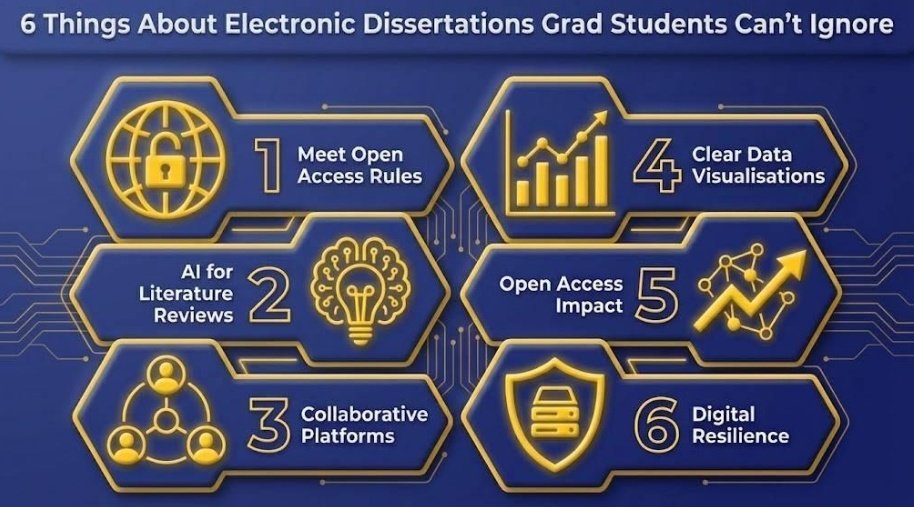
As you progress through your research, you will encounter 6 specific digital domains that will define your professional workflow. These are not merely suggestions; they are the standard practices of the modern UK research base. Find out more about them below:
1. Use Electronic Theses and Dissertations (ETDs) to Meet Open Access Requirements
UK research policy now expects most electronic dissertations to be online. For instance, PhD students on UKRI grants must deposit their final thesis within 12 months of graduation. Digital submission isn’t just modern; it’s often mandatory. Ignoring this can limit who sees your research and even affect your graduation. By using ETDs correctly, you ensure full compliance with university and funder rules and make your work accessible to future scholars.
In practice, meeting UK open-access rules means uploading your thesis to your university’s repository and (often) registering it with the national electronic thesis archive. In the UK, the British Library’s EThOS service aggregates theses from all universities. Every UKHE institution typically has its own repository. Depositing your electronic theses and dissertations there handles both local and UK-wide requirements. You can also use global tools like ProQuest or OATD for broader visibility.
| Aspect | Details | Practical Tip |
| File Prep | Convert your final draft to PDF/A format. | Use Adobe Acrobat’s “Save As > PDF/A” option or similar tool. Ensure all fonts are embedded. |
| Embargo Setup | Choose an embargo if needed. | UKRI-funded theses typically allow a 12-month embargo. Check your supervisor. |
| Submission Process | Upload your ETD via your university’s submission portal. Then register it on the national systems. | Do a test run with a dummy file to make sure you understand the steps. |
Do a test run with a dummy file to make sure you understand the steps. For a full breakdown of dissertation structure, including how to prepare and submit electronic dissertations, see this detailed guide: Structure & Argument Breakdown of 15000 Words Dissertation.
2. Use AI Tools to Conduct Efficient Literature Reviews
Searching thousands of articles manually is slow. AI-driven tools can cut your literature search time dramatically. For example, industry surveys predict smart tools could save busy professionals up to 12 hours per week. In PhD land, that means weeks saved for writing. Using extensions and visualisation tools helps you uncover relevant papers you might otherwise miss.
Key Benefits of Using AI
When you add AI and smart ETD database search extensions, the benefits stack up. Browser add-ons like Unpaywall find open-access versions of papers instantly and save you from paywalls. Tools like Connected Papers map out citation networks so you see related works at a glance. Also, the output remains compatible with UK data rules; you’re mostly scraping public article metadata, not personal info.
Step-by-Step Guide to Use AI for Electronic Dissertations
Using AI for research is easy, but you have to be directional. If you use LLM models without any strategy, they will give generic or hallucinated answers. Therefore, you need guidance to get better help for your electronic dissertations using AI. Here is a step-by-step guide for you:
- Install Extensions: Add Unpaywall and Connected Papers to your browser (free basic versions are available).
- Search Strategically: Enter your thesis keywords into Google Scholar or your favourite academic electronic thesis and dissertation database. Let Connected Papers show a graph of related works, and click Unpaywall icons to get PDFs legally.
- Collect Citations: When you find a good paper, export its citation to Zotero. Repeat until you have a manageable set (20–30 to start).
- Cross-Check Sources: Compare your AI-enhanced list with a manual search in libraries or Google Scholar to catch anything the tools missed.
3. Adopt Collaborative Platforms to Improve Teamwork
Collaboration tools eliminate tedious email chains and version conflicts when multiple people edit a university electronic theses. In the UK, remote supervision and group projects are common in PhD programmes. Platforms like Overleaf, Google Docs, or GitHub (for code) let you and your supervisor or co-authors work on the same file in real time. For instance, at Cambridge University, opening up Overleaf to the whole research community led to a five-fold increase in projects within 9 months.
As these platforms improve, they’ll handle even bigger teams and complex workflows. Already, integrated reference managers and code notebooks are coming to platforms like Overleaf and Google Docs. Soon, you may co-author with colleagues from multiple universities all in one place. Here is a quick guide on the use of these adopt collaborative platforms:
| Step | Action | Notes for UK Users |
| Account Creation | Sign up for Overleaf | Use your “@*.ac.uk” email to potentially get an institutional upgrade. |
| Project Launch | Start a new project and upload your thesis chapter | Generate a shareable link for your supervisor. |
| Collaboration Start | Enable track changes/history. Invite teammates via email link. | Overleaf works well with LaTeX (popular in Oxford STEM) and also supports Word uploading. |
4. Create Data Visualisations to Communicate Findings Clearly
A good chart is worth a hundred words. Thesis examiners and funders in fields like environmental science or economics often expect clear visuals of your data. According to EPSRC guidance, compelling figures can strengthen funding reports and publications. For example, at Reading University, environmental PhD candidates routinely embed charts in EPSRC grant proposals to illustrate trends.
Future Integration
Visualisation tools are getting smarter. Look out for features like live data feeds or interactive web viewers. Eventually, your thesis could link to up-to-date charts whenever data is refreshed. Here is your checklist to create visualisations:
- Download Software: Install Tableau Public (free) or use Excel/Google Sheets for electronic dissertation download.
- Import Data: Prepare your dataset and import it. Drag-and-drop rows into the interface.
- Choose Chart Type: Use a bar/column chart for comparisons, a line chart for trends, and a scatter plot for correlations.
- Customise: Add a clear title, label axes fully, and choose readable colours. Include a short caption or tooltip if the software allows.
- Export for Thesis: Once ready, export the chart as a PNG or JPEG. Insert this image into your thesis PDF.
5. Follow Open Access Practices to Increase Your Research Impact
Sharing your work openly means more people can read and cite it. Studies show that electronically available dissertation access articles get cited more often than closed ones. Even if your thesis isn’t a journal paper, a freely accessible thesis or related paper gets eyeballs globally. In fact, an analysis of 420 million citations found that open-access outputs attract citations from more diverse regions than paywalled ones.
Tips to Increase Your Research Impact
Open access practices are not that easy to follow. To increase your research impact, you have to be strategic. For example, choosing a topic or selecting resources with wide coverage. Here are some tips for you to increase your research impact:
- Find Journals and Repositories: Look at the journals in your field on the DOAJ (Directory of Open Access Journals). If you plan to publish, you might choose an open-access option. Also, ensure you know your digital thesis repository name.
- Use Unpaywall: When you find relevant papers, click the Unpaywall icon. It shows if an open version exists. This can guide you to freely available literature to cite or help you deposit your own papers.
- Deposit Anywhere: Besides your university’s portal, upload a copy of your manuscript or thesis to CORE.ac.uk as a backup. CORE harvests many UK repositories and provides a permanent record.
- Monitor Usage: Many repositories have metrics. Check how many downloads or views your thesis gets. In fact, some UK repos and tools like Figshare let you see downloads and geographic reach.
6. Develop Digital Resilience to Protect Against Threats and Fatigue
As you move deeper into your research, you will find that “digital resilience” is just as important as your physical stamina. This means protecting your data from catastrophic loss and protecting yourself from the mental fatigue of constant screen time. In fact, surveys of scientific data show that up to 80% of original research data can become inaccessible over 20 years.
UK institutions embed data security in policy. For example, Birmingham City University’s research guidelines remind us that the UK GDPR and Data Protection Act don’t fix retention times, but they do require secure handling of personal data.
How to Build Resilience for your Electronic Thesis and Dissertations?
Building resilience for your electronic thesis and dissertations is not just about motivation. It is about protecting your work and using the right academic support systems including professional dissertation writing help when needed.
Start by setting up automatic encrypted backups using reliable tools such as Backblaze or your university-managed storage like OneDrive. This can be done in under 20 minutes and ensures your research is protected from accidental loss or system failure. On top of that, encrypt sensitive files and verify backups weekly. Don’t forget to keep a monthly offline “disaster copy” on an external drive. These steps protect years of work with minimal effort.
Conclusion
Digital tools and practices are no longer optional extras; they are core to today’s research process. The 6 areas above form a connected workflow for etd electronic theses and dissertations. You write your thesis as an electronic dissertation to meet open-access mandates, find sources faster with AI and collaborate online with co-researchers. Plus, you can present your findings in clear charts and share them openly to maximise impact. Finally, defend your work with secure backups and focused habits.
Looking forward, these practices prepare you for a changing UK research landscape. More journals and funders will expect openness. Building these habits now gives you a head start. In the future, you might click a button to auto-deposit or see live-updating figures in your thesis. By mastering the digital workflow today, you become the tech-savvy researcher that UK academia is heading towards.
Frequently Asked Questions about Electronic Dissertations
1. How is an electronic dissertation different from a printed one?
The key difference is format and accessibility. In digital form, your text is searchable and easily shareable online. You can include web links, appendices, or even embedded objects. Unlike print, an ETD can reach readers worldwide instantly. Practically, you still follow your university’s structure guidelines, but submit a file instead of a binding. After that, your dissertation content doesn’t change, only how it’s delivered and who can get ETD library access.
2. Are electronic dissertations accepted by all universities in the UK?
Yes. UK universities have largely moved to digital submission. For instance, Cambridge requires all graduates to upload an electronic copy of their thesis to the electronic thesis and dissertation repository. At Edinburgh (Arts and Humanities), master’s by research submissions are 100% digital. Most UK institutions follow similar policies. In short, electronic submission is now the norm and accepted across the board.
3. Can I include multimedia like videos or audio in an electronic dissertation?
Often you can include, but check your uni’s rules. The digital format does allow it. For example, PDF/A supports embedded content. However, most repositories have policies on supplementary materials. Typically, you would upload any videos, audio files, or datasets as separate files linked to your thesis. Some universities let you embed links to external hosting.

Watch Winder vs. Watch Box: What Does Your Automatic Watch Collection Actually Need?

What Is the Best Time to Visit Crystal River for Outdoor Adventures?

How South Africans Are Tackling Debt Consolidation in a High-Interest Economy

How Regular Dental Visits Help You Avoid Unexpected Dental Emergencies

Redefining parenting style with fashion-forward baby gear

How to Make Your Money Work Around an Irregular Income

A Complete Guide To Professional Teeth Whitening Treatments

How to Evaluate a Luxury Watch Before Buying: Materials, Movement, Fit, and Long-Term Value

Why So Many UK Businesses Are Still Overpaying for Energy in 2026

Luxury Smelling Local Perfume Brands from Dubai to Try

Who Is Jennifer Rauchet?: All You Need To Know About Pete Hegseth’s Wife

Who Is Mindy Jennings?: All You Need To Know About Ken Jennings Wife

Who Is Klarissa Munz: The Untold Story of Freddie Highmore’s Wife

Who Is Mallory Plotnik?: The Untold Story of Phil Wickham’s Wife

Who Is Enrica Cenzatti?: The Untold Story of Andrea Bocelli’s Ex-Wife

Can Anything Be Done About the Skyrocketing Prices of Essential Medicines?

Meet Christina Erika Carandini Lee?: All You Need To Know Christopher Lee’s Daughter

Who Is Jasmine Gong?: The Life and Legacy of Brad Williams Wife

Who Is Allison Butler?: The Life and Influence of Kirk Herbstreit Wife

Who Is Terrance Michael Murphy?: Everything about Audie Murphy’s Son
Watch Winder vs. Watch Box: What Does Your Automatic Watch Collection Actually Need?
What Is the Best Time to Visit Crystal River for Outdoor Adventures?
How South Africans Are Tackling Debt Consolidation in a High-Interest Economy
How Regular Dental Visits Help You Avoid Unexpected Dental Emergencies
Redefining parenting style with fashion-forward baby gear
How to Make Your Money Work Around an Irregular Income
A Complete Guide To Professional Teeth Whitening Treatments
How to Evaluate a Luxury Watch Before Buying: Materials, Movement, Fit, and Long-Term Value
Why So Many UK Businesses Are Still Overpaying for Energy in 2026
Luxury Smelling Local Perfume Brands from Dubai to Try

 Celebrity2 years ago
Who Is Jennifer Rauchet?: All You Need To Know About Pete Hegseth’s Wife
- Celebrity2 years ago
Who Is Mindy Jennings?: All You Need To Know About Ken Jennings Wife
- Celebrity2 years ago
Who Is Klarissa Munz: The Untold Story of Freddie Highmore’s Wife
- Celebrity2 years ago
Who Is Mallory Plotnik?: The Untold Story of Phil Wickham’s Wife